
NFPA 72 code sections · Devices & Signal Flow: How the Panel Hears and Speaks
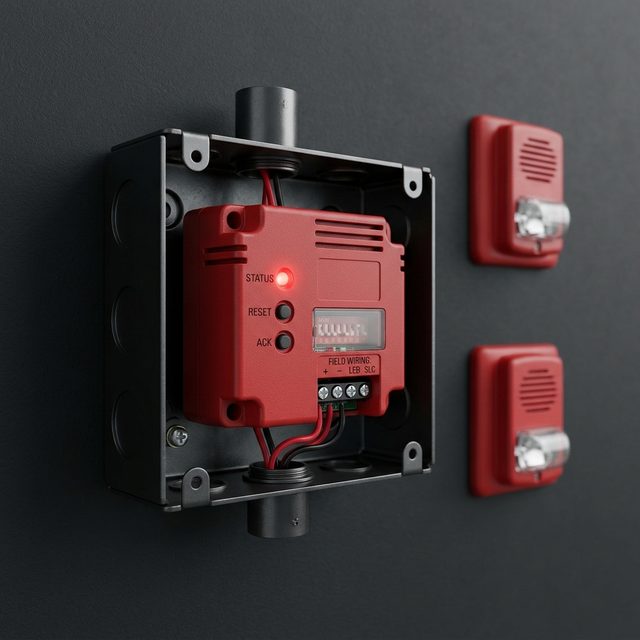
Control module: a supervised output the panel can trust
A control (output) module is how an addressable panel drives a circuit of conventional appliances or equipment and knows it is still connected. On command from the panel it switches power onto a notification appliance circuit of horns, strobes or speakers, or operates a releasing circuit or a bell — and while idle it supervises that circuit with an end-of-line device so an open, short or ground shows up as a trouble before the night it is needed. Because its outputs are notification appliances or extinguishing controls, the control module inherits their rules: activation within 10 seconds of the panel's alarm decision, the Temporal-3 pattern and synchronization carried through to the appliances, and releasing-service listing where it actuates suppression. Typical uses: a NAC of horn/strobes in a remote wing, a speaker circuit on a floor, a water-motor gong, a pre-action releasing solenoid, a sounder base circuit.
NFPA 72 reference
Chapter 12 / Chapter 18 / Chapter 23
12.6 Monitoring Integrity (supervised notification appliance / releasing circuits); 18.4.2 and 18.5.4 pattern and synchronization delivered to the appliances; 10.11.1 activation within 10 s; 23.13 releasing-service requirements where the module actuates suppression
References use NFPA 72 2019/2022 numbering — section numbers can shift between editions, so confirm in the edition your AHJ has adopted.
On the job, step by step
- The panel declares an alarm from a third-floor smoke detector.
- It commands the control module in the third-floor electrical room to activate; the module switches 24 V from the local power supply onto the NAC of eight horn/strobes.
- The horns sound Temporal-3 and the strobes flash in sync within 10 seconds of the alarm decision.
- Two weeks earlier, when a strobe's wire had been nicked, the same module had reported 'NAC OPEN — 3RD FLR' as a trouble — the reason the appliances were ready tonight.
Quick check
1. A control module differs from a relay module mainly because it:
2. A control module driving horns and strobes must deliver:
3. A control module that actuates a pre-action sprinkler solenoid falls under:
Listen to this section
AI-narrated, about a minute.
Ask about this section
Get a plain-language explanation of what this rule requires and what to check on the job.
3 free explanations left on this device.